Apartments in Southside Jacksonville, FL: What the Area Is Actually Like
A neighbourhood guide to Southside Jacksonville: what the Gate Parkway and St. Johns Town Center corridor is built around, what a normal week there looks like, what apartments cost as of 5 October 2026, and the honest constraint that nothing here is walkable.
Southside is the part of Jacksonville built around the Gate Parkway and St. Johns Town Center corridor, and it is one of the easiest submarkets in the city to rent in and one of the hardest to understand from a listing page. Apartments in Southside Jacksonville, FL sit among large-format retail, office parks and six-lane arterials, which produces a specific kind of daily life: enormous convenience if you drive, almost none if you do not. This guide covers what the corridor is built around, what a normal week looks like, and which renters it genuinely serves.
Where Southside actually is, and what counts as being in it
Southside is a broad designation and people use it loosely, which is the first thing to sort out. When renters say Southside they usually mean the band of the city east of the St. Johns River and south of the Arlington Expressway, organised around Southside Boulevard and J. Turner Butler Boulevard, with Gate Parkway and Deerwood Park as its commercial centre of gravity.
That centre of gravity matters more than the boundary. The 32216 and 32256 postcodes around Gate Parkway and Deerwood carry most of the newer apartment stock, most of the office employment and essentially all of the large-format retail. A listing that says Southside but sits twenty minutes west of that is a different place with a different daily pattern. Check the cross streets, not the neighbourhood name.
What the corridor was built around
This is the part that explains everything else. The Southside corridor was not a neighbourhood that gradually acquired shops. It was built the other way round: the retail and the offices came first, at a scale drawing from the whole metropolitan area, and the apartments followed to house the people working in them.
St. Johns Town Center is the anchor — a large open-air shopping and dining complex that functions as a regional destination rather than a local high street. Around it sits a ring of big-box and warehouse-club retail, and behind that, Deerwood Park and the Butler Boulevard employment base, which together hold a substantial share of Jacksonville's white-collar office jobs. The apartment communities fill the gaps between them.
The consequence is a corridor with extraordinary commercial density and no traditional centre. There is no main street, no square, no cluster of shopfronts you walk between. There is a good cinema, a good supermarket, a warehouse club and several hundred restaurants, all in separate parking lots. Grasping that this is infrastructure rather than neighbourhood is the most useful thing a renter can do before touring here.
The thing nobody puts in the listing: you will drive everywhere
Southside is not walkable. That includes groceries.
It is worth stating plainly because the listings will not. Walk Score rates the Deerwood neighbourhood 16 and Deerwood Center 28, both squarely in the car-dependent band, meaning virtually every errand requires a vehicle. That matches the physical reality: the corridor is organised around arterial roads with long signal cycles, wide crossings and stretches of incomplete sidewalk, and the distances between destinations were set by parking-lot geometry rather than by foot traffic.
The Florida climate compounds it. A fifteen-minute walk in open July sun with no shade is a walk you attempt once. Treat any route crossing Southside Boulevard or Butler Boulevard at grade as a drive, whatever the map suggests.
What you get in exchange is short drives. From the Gate Parkway area, off-peak, a cinema is about four minutes away, a full supermarket about five, a warehouse club about nine, the interstate about nine, the Town Center about ten and the Atlantic about twenty-four. None is a long journey. But each is a journey, and if you are moving from a city where you walked to a corner shop, that is the real adjustment — not the rent, not the square footage.
If a walkable daily life is non-negotiable, this is the wrong submarket and you should be looking at Riverside, San Marco or the beaches communities instead. There is no version of the Southside that solves that.
What a normal week looks like here
Accepting the car, the weekly pattern is unusually efficient. A single trip out of the corridor covers a supermarket, a pharmacy, a hardware store and dinner, because they are within a few minutes of each other. Errands that take a whole Saturday in a denser city collapse into an hour here.
Weekday traffic is the tax. Southside Boulevard and Butler Boulevard carry heavy commuter volume in the known directions at the known hours, and an off-peak ten-minute drive can run closer to twenty at peak or through the December retail season. Any drive time you read anywhere, including the ones here, is an off-peak measurement.
Weekends run the other way. Because so much local employment is office-based, the office parks empty and the residential streets go quiet while the retail ring gets busy. Inside the apartment clusters rather than on an arterial, Saturday mornings are genuinely peaceful in a way that surprises people expecting a commercial district to be loud.
Who the Southside genuinely suits
It suits commuters to the Southside, Deerwood Park and Butler Boulevard office base above all. If your workplace sits in that cluster, living here turns a cross-town commute into a short local drive, which is the strongest single argument for the submarket.
It suits people wanting recent construction with real square footage. The stock here skews newer than the historic districts, meaning in-unit laundry, modern kitchens and larger floor plans at prices the walkable neighbourhoods do not match.
It suits households with cars and errands — families, roommates, anyone who buys in bulk and values a warehouse club nine minutes away. And it suits people who want the beach reachable without living at beach prices, at roughly twenty-four minutes off-peak.
For a fuller breakdown of which renter profiles fit a Gate Parkway address and which do not, the companion guide on who Citigate is best for works through the trade-offs profile by profile.
Who should look at a different part of Jacksonville
Anyone who wants to walk to dinner. Anyone without reliable access to a car. Anyone who wants a historic building, a street of independent shopfronts, or the feeling of a neighbourhood with a centre. Anyone whose work is downtown or on the Northside, for whom this location adds a commute instead of removing one. And anyone who wants nightlife within walking distance, which does not exist here in any form.
None of that is a criticism of the corridor. It is a different product, and the renters unhappy here are almost always the ones who wanted the other thing.
What apartments on the Southside cost
Southside sits mid-market for Jacksonville: dearer than the older stock further west, cheaper than the beaches and the premium riverfront districts, with newer buildings and more space than either comparison implies.
As a concrete reference point from one community on the Gate Parkway corridor, as of 5 October 2026, one-bedrooms run from the low $1,400s to the upper $1,500s, two-bedrooms from the low $1,600s to the upper $1,800s, and three-bedrooms sit right around the $2,000 mark. The step from a one-bedroom to a two-bedroom is roughly two hundred dollars. Those are bands rather than quoted prices for a reason: apartment pricing in this market is managed algorithmically and moves daily, so treat any figure as a starting orientation and confirm the current number with the leasing office.
The square footage is where the submarket argues for itself. One-bedrooms in this corridor commonly run from around 800 to 860 square feet, two-bedrooms from roughly 1,100 to 1,200, and three-bedrooms past 1,400. That is meaningfully more space than equivalent money buys in the walkable districts.
How the Southside compares with the rest of the city
The short version: Southside trades walkability for space, newness and retail access, and is the best value in Jacksonville if you were going to drive anyway.
Within the Southside itself there are several distinct corridors — Gate Parkway, Baymeadows, Deerwood Park and Southside Boulevard — and they differ from one another in building age, traffic pattern and price more than the raw mileage between them suggests. That comparison is worked through corridor by corridor, along with the honest answer on walking distance to the shops, in the companion guide to apartments near St. Johns Town Center. If you have narrowed to this submarket and are now choosing between corridors inside it, start there.
One address on the corridor, as a reference point
To make the above concrete rather than abstract, Citigate sits at 8451 Gate Parkway West in 32216, in the middle of the corridor this guide describes, and the drive times quoted throughout are measured from it.
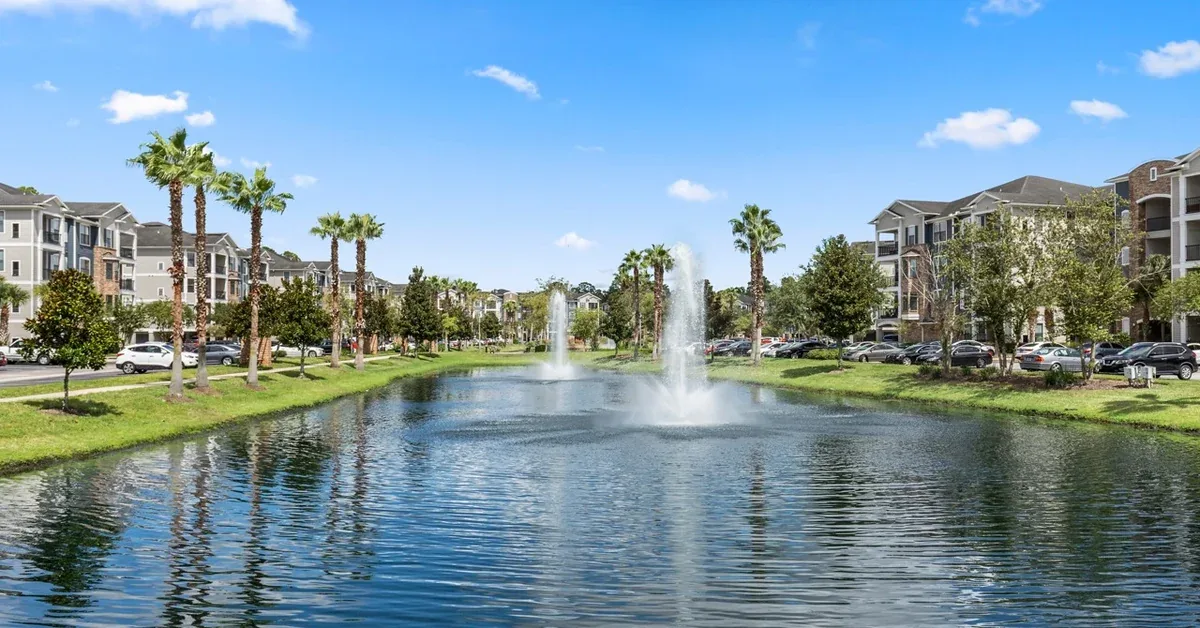
It is a useful reference point because it is typical of what the corridor produces: a lake with fountains and an earth bridge at its centre, a swimming pool, a fitness centre with a yoga room, an indoor theatre room, a dog park, a playground, outdoor grills, a fire pit, and a business centre and resident clubhouse. Those are the amenities the corridor's newer communities compete on, and they exist because there was land to build them on — the same reason nothing is walkable.
It is explicitly not walking distance to the Town Center, and does not claim to be. Ten minutes by car is the trade this entire guide has been describing. A fuller account of the community itself, including floor plans and what it does not offer, is in the Citigate renter's guide.
Drive times quoted here are off-peak measurements and will be longer at rush hour; drive your own route at your own commuting hour before signing. Rent bands are checked as of 5 October 2026 and are managed algorithmically, so they change frequently — confirm current pricing and availability with the leasing office. Walkability ratings are Walk Score neighbourhood ratings for Jacksonville, accessed 5 October 2026.
Frequently asked questions
Is Southside a good place to live in Jacksonville?
It is a good place to live if you drive and want space, newer construction and short errands, and a poor one if you want walkability or a neighbourhood centre. The submarket is unusually clear-cut: renters who match its pattern tend to be satisfied, and those who wanted a walkable district tend not to be.
Can you live in Southside Jacksonville without a car?
Realistically, no. Walk Score rates the Deerwood area 16 and Deerwood Center 28, both car-dependent, and the corridor's arterial road layout means even short distances involve crossing multi-lane roads with incomplete sidewalk. Groceries are a drive. Treat a vehicle as a requirement rather than a convenience.
How far is Southside Jacksonville from the beach?
About twenty-four minutes off-peak from the Gate Parkway area to Jacksonville Beach. That is close enough for a routine weekend trip and far enough that you are not paying beach-adjacent rent.
What is the commute like from Southside?
Short if you work in the Southside, Deerwood Park or Butler Boulevard cluster, often under fifteen minutes. Longer if you work downtown or on the Northside. Peak traffic on Southside and Butler Boulevards is heavy in the predictable directions, and a ten-minute off-peak drive can approach twenty at rush hour.
Is Southside Jacksonville suitable for families?
It works well for families who drive. Newer communities carry three-bedroom floor plans past 1,400 square feet, playgrounds and pools, and the retail density makes household logistics straightforward. The limitation is the same as everywhere here: children cannot walk anywhere independently.
What do apartments in Southside Jacksonville rent for?
As of 5 October 2026, a representative Gate Parkway community runs one-bedrooms from the low $1,400s to the upper $1,500s, two-bedrooms from the low $1,600s to the upper $1,800s and three-bedrooms around $2,000. Pricing in this market changes daily, so confirm current figures directly with any community you are considering.
Is the Southside noisy, given all the retail?
Less than you would expect. The commercial density concentrates along the arterials and the Town Center ring, while the apartment clusters sit back from them. The office-park character also means the area empties on weekday evenings and weekends rather than filling up.
What is the difference between Southside and the St. Johns Town Center area?
The Town Center is a retail destination inside the Southside, not a separate neighbourhood. Living "near the Town Center" and living "in the Southside" usually describe the same corridor; the former is a marketing phrase about proximity to shops, the latter a description of the submarket as a whole.
Is Southside better than Riverside or San Marco for a first move to Jacksonville?
It depends on whether you want to drive. Southside gives more space for the money and easier errands; Riverside and San Marco give walkability, independent businesses and older character at a premium. For a first move, the deciding question is whether a car-dependent routine is acceptable to you.
Which part of the Southside should I actually choose?
That comes down to the corridor rather than the submarket — Gate Parkway, Baymeadows, Deerwood Park and Southside Boulevard differ in building age, price and traffic pattern. Narrow to the submarket first using this guide, then compare corridors against each other.